
CELEBRATING A COLORFUL PAST
BATIK WORKSHOP AT AGRASEN KI BAOLI
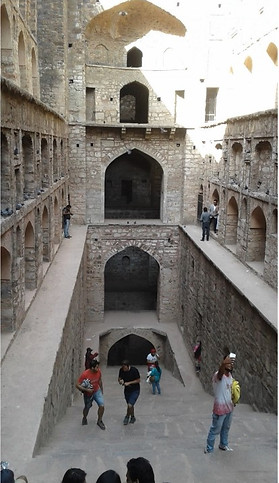
Agrasen Ki Baoli is a 16th Century Baoli or Stepwell located in Connaught Place, Central Delhi, India. It was built by King Agrasen to provide constant water supply and a bath for people in his Kingdom.
The Stepwell measures 58 meters long and 13 meters wide approximately, and was constructed by a technique called rubble masonry, which involves putting together uneven stone units. The Baoli is divided into 4 levels with a flight of 108 steep steps leading down to the well. The well is in the northern end and measures 7.8 meters in diameter. Built in Mughal era, the structure consists of key elements of Mughal architecture - simplicity, minimal ornamentation, and usage of stone. Being an archaeological site of national importance, the stepwell attracts a large amount of local and international tourists. It is protected under ASI (Archaeological Survey of India) which is responsible for its maintenance and upkeep. Module: Design Studio Year: 2017
ABOUT AGRASEN KI BAOLI


The Well area


HISTORY AND BACKGROUND OF ANCIENT STEP WELLS OF INDIA

By definition, step wells were structures built in arid or semi-arid regions to collect rainwater and ensure year - round water supply. However, its background is much more complex and in order to understand the site Agrasen Ki Baoli in its true sense, one should know about the step wells through different eras of Ancient India.
Timeline showing stepwells through various eras of Indian History

Mohenjo Daro, built around 2500 BCE, was one of the largest and earliest major urban settlement located in the Indus valley. The Great Bath is one of the best-known structures among the ruins of the ancient civilisation. Measuring 55 meters long and 33 meters wide, it is the first structure to be associated with step wells in history. It had steps from all four sides leading down towards the central pool. There were galleries and rooms on its sides which might have been used as changing rooms. According to research, it is suggested that The Great Bath was used as a ceremonial site where people in large numbers used to go to take bath.
MOHENJO DARO
Ruins of The Great Bath, Sindh, Pakistan

Indian subcontinent was dominated by Jains and Buddhists from 1st to 5th century. Their main belief was non - violence (ahimsa) and respect towards all living beings. As a result, both promoted vegetarianism. Their monks promoted agriculture to avoid killing of animals for hunger. Wells were developed to irrigate the agricultural fields. Also, water was used as a portal to be closer to god. Their saints and pilgrims believed in non – attachment and established their solitary meditation places near water catchment areas.
JAINS AND BUDDHISTS
Earliest example of Stepwells, Adi – Kadi Stepwell in Junagadh, Gujarat, Buddhist (Upercot) Caves, 4th century


During the Hindu era, the society became more civilised and architecture more complex and advanced. Two water structures were commonly built in order to cater to the needs of people –
• Step wells - Step wells were used for rainwater harvesting. They were much deeper and mostly found in arid regions to ensure year round availability of water resources. They were treated like a water machinery.
• Step ponds - Step ponds were used for ritual bathing and therefore they were built near temples or religious places. According to the Hindu context, the dialogue between God and Hindus occurred outside temples in step wells. Standing in water to pray as the sun rose, was considered to be fruitful for the person.
HINDUS
Step well
Step pond

Simplicity was the key feature of Mughal Architecture
MUGHAL EMPIRE
The Mughal period saw a cultural gulf between Hindus and Muslims. Muslims destroyed many Hindu temples and other buildings in order to establish their rule in the subcontinent. However, step wells were left intact since they did not want to compromise with the availability of water. Their distaste for ornamentation led to the creation of simpler structures. They also rejected the usage of Hindu deities in step wells. These wells were a perfect example of powerful fusion between Hindu and Muslim religious and architectural ideas.
BRITISH EMPIRE


India’s colonialism changed the public water system and saw the decline of step wells. The British focused more on developing sophisticated buildings rather than the primitive step wells. They were considered to be unhygienic and were soon replaced by the latest hydraulic engineering. Taps were installed in villages and towns and people no longer bothered to maintain or clean the step wells.
Baoli in ruins
Currently, government organisations like ASI (Archaeological Survey of India), INTACH (Indian National Trust for Art and Cultural Heritage), and ICHR (Indian Council of Historical Research) are concerned with maintaining these palatial structures. Their historical value and unique architecture attracts many tourists.
LOCATION

The Baoli is located in Connaught Place, Central Delhi which was developed in 1933 as a shopping destination when the British ruled India. During the British era, the shopping centre was surrounded by bungalows most of which have today been converted into residential and office high rise buildings. Over the years it has developed as a premier most commercial area of the country and also a cultural centre with many national and international cultural houses, museums and art galleries. There are many hotels in the vicinity as well.
AGRASEN KI BAOLI

Location Map - Connaught Place (Central Delhi)

Site map
AGRASEN KI BAOLI
PROPOSED PROGRAMME
BATIK PRINTING WORKSHOP

Modern Batik Painting by Lukandwa Dominic
ABOUT BATIK ART
The word Batik means - wax writing. History of Indian Batik can be traced as far as 2000 years. Ancient India had a flourishing trade of fabric and dyes, which were eminent in supporting the art. Initially, it was considered as a fitting occupation for the aristocratic but later it became a common practice and was used extensively to capture religious and folk stories. Hindu society was highly devotional and spiritual. Batik enabled to convey these ideas in the form of art masterpieces.
The technique of Batik involves the fabric to be washed and dried many times. Step wells provided a ready made platform to perform these activities. The well area was used for soaking and washing the cloth which was later spread on the steps to dry. This type of arrangement is a fine example of interaction between, architecture, community and art in Ancient India.
Step wells were regarded much more than a water machinery by the communities which used them. It played an important role in bringing together people and celebrating the elixir of life i.e, water. The objective of this project is to introduce a batik workshop in the vicinity to bring back the essence which existed many centuries ago.
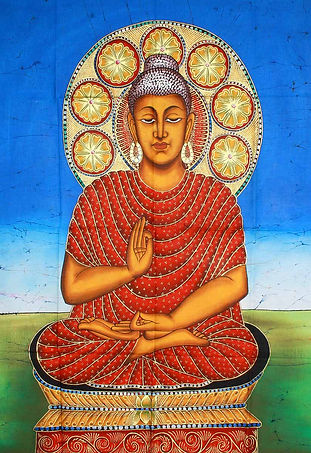
Lord Buddha Batik painting
FINAL DESIGN

DESIGN DEVELOPMENT
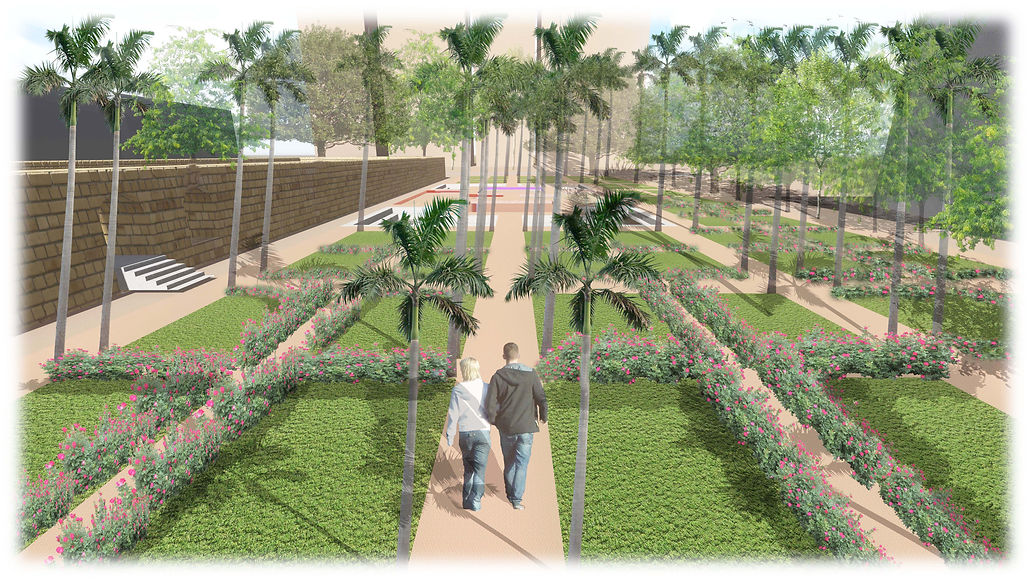
Agrasen ki Baoli was built in 16th Century, when the Mughals ruled India. They adopted a unique style of landscaping which was highly disciplined and formal. Mughal Gardens have been a source of inspiration for designing this project.
Some key elements of Mughal Gardens include –
- the Charbagh structure (dividing the garden into four equal quarters),
- use of rectilinear layouts,
- waterworks,
- stone pathways,
- pathways lined with the same species of trees.


Mughal Garden Layout
Taking Grid lines from the Step wells arches
Rectilinear grass patches made from the Grid lines
Developing further using elements of Mughal Gardens
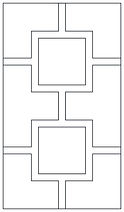
Common setting used in Mughal Gardens

Four - gardens structure
Water feature
Colored glass
Stone pathway
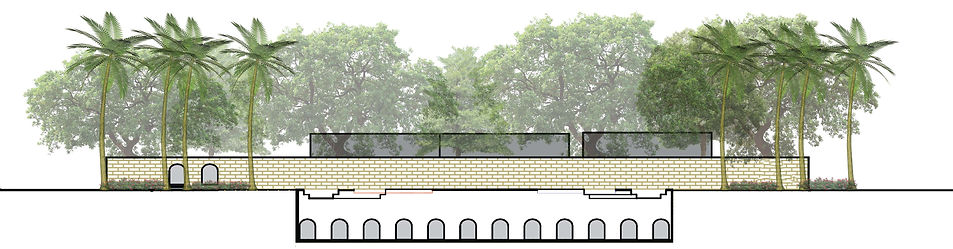
Section


3D MODEL
3D Model in 1:500 Scale
